I have been asked to write, giving some information to my English speaking audience around the world about Iranian ( Persian) Poets and poems. So from now on I will be giving a short biography of a Persian poet and a sample of his/her work, Starting with Shamloo who once was nominated for the Nobel Prize in Literature.
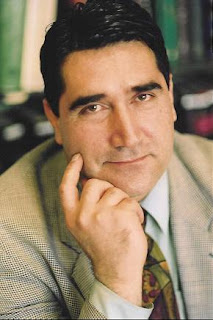
Ahmad Shomlou
Born
December 12,
1925(1925-12-12)
Tehran,
IranDied
July 24,
2000 (aged 74)
Karaj,
Iran (Shamlou is buried beside
Emamzadeh Taher's
Shrine(صحن امامزاده طاهر، کرج)
Occupation
Poet, writer, interpreter and journalist.
Ahmad Shamlou (
Persian: احمد شاملو) (
December 12,
1925 —
July 24,
2000) was a
Persian poet, writer, and journalist. His poetry was initially very much influenced by and was in the tradition of
Nima Youshij. Shamlou's poetry is complex, yet his imagery, which contributes significantly to the intensity of his poems, is simple. As the base, he uses the traditional imagery familiar to his Iranian audience through the works of Persian masters like
Hafez and
Omar Khayyám. For infrastructure and impact, he uses a kind of everyday imagery in which personified oxymoronic elements are spiked with an unreal combination of the abstract and the concrete thus far unprecedented in Persian poetry, which distressed some of the admirers of more traditional poetry.

Shamlou has translated extensively from
German and
French to
Persian and his own works are also translated into a number of languages. He has also written a number of plays, edited the works of major classical Persian poets, especially
Hafez. His six-volume
Ketab-e Koucheh (The Book of the Alley) is a major contribution in understanding the Iranian folklore beliefs and language.
Aside from his first passion which was poetry, he had a number of other activities which included writing stories and film scenarios, contributing to children’s literature, and journalism.

Shamlou had been called the most influential Iranian poet of this century. In a land where poetry is considered part of national identity, this was no small accomplishment. He was also a distinguished journalist with a witty and powerful language and humanistic views that brought him enemies as well as many friends.

Shamlou was a secular intellectual and humanist who was an icon for those who believe people deserve better treatment than what they received under the monarchist and the Islamic regimes. A long time ago he wrote: "My fear is to die in a land in which the wages of a grave-digger are more valuable than human freedom." In the tradition of great poets like Pablo Neruda and Nazim Hekmat, Shamlou found his source of inspiration among people's myths and tales.


One of his greatest accomplishments was a monumental encyclopedia of Iranian folklore called Book of the Street. This undertaking, which is in tens of volumes, has not been allowed complete publication by the Islamic regime.

Most of Shamlou's poetry evolved around the concepts of humanism, love and freedom, with all the complexity and mysticism love has in Iranian literature. Humanism is a universal concept in his poetry. He wrote poetry about "Vietnam's comrades" and any other human being who fought to be free. He started a project to introduce the most important poets from other countries to the Iranian public, which resulted in a series of audio tapes that popularized the poetry of Langston Hughes, Garcia Lorca and Margot Bigel. During the years 1953-1973 when the opposition to the Shah was broken and stagnation became the main feature of political life in Iran, Shamlou did not lose his humanistic views. During his years of pessimism, he wrote love poetry for his love Aida. But even the love poems were universal rather than being an individual expression.


His death is mourned by those who value the human soul and emotions because he was the poet of our soul. Tens of thousands in Tehran attended his funeral with red roses in their hands and his poetry on their lips.


Chronology of Ahmad Shamlou's Life & Work
1925- Ahmad Shamlou (or Shamloo) was born on December 12 in Tehran to a family that was to move around Iran because of the duties of his father who was an army officer.
1938- Shamlou leaves high school to enroll in the Technical College of Tehran.
1942- His father takes him to the north of Iran, which was occupied by the Soviet Army.
Shamlou is arrested by the Red Army for his political ideas and is sent to Rasht.
1945- Shamlou is released from jail and leaves with his family for Azerbaijan. The separatists arrest him and his farther for a short time. They are sent back to Tehran. Shamlou decides to leave school for good.
1947- First marriage. First collection of poems: The Forgotten Songs.
1948- He writes in a literary weekly called "Sokhan".
1950- His first short story is published: "The Woman Behind the Brass Door".
1951- Second collection of poems: Manifesto. He shows clear inclinations toward Socialist ideology. Shamlou serves as one of the editors of "Khandaniha".
1952- He gets a job in the Hungarian embassy as their Cultural Advisor.
1953- His third collection of poems, Metals and Sense, is banned and destroyed by the police.
His translations of Gold In Dirt, by Sigmund Motritz, and the voluminous novel The Sons Of A Man Whose Heart Was Made Of Stone, by Morio Kai, together with all data gathered for his work on the colloquial culture of urban Iranian life (to be known as The Book Of Streets) are also confiscated and destroyed. He escapes and goes into hiding.
1954- He is arrested and kept in jail for 14 months.
1955- He is freed. His four new collections of poems are taken and lost by a publisher. He translates and publishes three novels by European writers.
1956- He becomes the editor-in-chief of "Bamshad" literary magazine. He is separated from his wife after having two sons and one daughter.
1957- His masterpiece, The Fresh Air, a collection of poems that will influence Persian poetry profoundly, is published. He also publishes a few studies on classic Iranian poetry. He marries for a second time.
1958- His translation of Barefoot, a novel by Zaharia Stancu, is released, establishing Shamlou's authority as a translator.
1959- He begins publishing short stories for children, as well as directing documentary films and working for film studios.
1960- A new collection of his poems, The Garden of Mirrors, is released.
1961- He suffers a bitter separation from his second wife. He becomes editor-in-chief of "Ketab-e-Hafte", a magazine that changes the tradition and language of literary journalism in Iran.
1962- He meets Ayda, beginning a loving relationship that has lasted until today. His translations of Andre Gide and Robert Merl are published.
1964- He and Ayda are married. Two collections of his poetry are published: Ayda in Mirror and Moment and Eternity.
1965- A new collection of poems is released: Ayda, Trees, Memories And The Dagger. He has a new translation published. He also begins his third attempt to compile The Book of Streets.
1966- Another new collection of poems is published: Qoqnus In The Rain. His literary magazine is banned by the Ministry Of Information.
1967- He becomes editor-in-chief of "Khushe". His new translation of Erskine Caldwell is published. He participates in the formation of the Union of Iranian Writers and gives several poetry readings at Iranian universities.
1968- He begins his study of Hafiz, the classical grand poet of the Persian language; translates Garcia Lorca's poems and the Song Of Solomon from the Old Testament; organizes a week of poetry reading for established and new Iranian poets, which is very well received. The poems debuted at this event appear in a voluminous book edited by Shamlou.
1969- His weekly magazine is closed down by the police. Of The Air And Mirrors, a selection of older poetry, is published, together with his collection of new poems, Odes For The Earth.
1970- New collection: Blossoming In Mist. He directs a few documentary films for television and publishes several short stories for children.
1971- He redoes some of his earlier translations. His mother dies.
1972- He teaches Persian literature at Tehran University. Several audio cassettes are released of Shamlou reciting other classical and modern poets' work. He obtains membership in the Iranian Academy of Language. He publishes several new translations and writes a few film scripts. He travels to Paris for medical treatment.
1973- Two new collections, Abraham In Fire and Doors And The Great China Wall, are released, along with several new translations.
1975- Publication of his work and study of Hafiz.
1976- Travels to the United States and gives poetry readings in many cities. He participates in the San Francisco Poetry Festival before returning to Iran.
1977- New poem: "Dagger On The Plate". He leaves Iran in protest of the Shah's regime and stays in the United States for a year, giving lectures in American universities.
1978- He leaves the United States for Britain to act as the editor-in-chief for a new publication called "Iranshahr"; resigns after 12 issues and returns to Iran just after the advent of the Revolution; rejoins the Union of Iranian Writers; begins publishing a new periodical, "Ketab-e-Jom'e" to great success. This very active year in his life sees him publishing many poems and translations, as well as giving numerous lectures and readings. He is also elected to the membership of the Writer's Union's leadership. He is at this point considered the finest Iranian poet.
1979- Another year of intensive activity on different fronts. The first and second volumes of The Book of Streets go to print. He is re-elected as member of Writer's Union leadership.
1980- Starting now, owing to the harsh political situation in his country, he would lead a rather secluded life that would last for the next eight years, working with Ayda on The Book Of Streets, as well as many other literary endeavors, including a translation of And Quiet Flows The Don by Mikhail Sholokhov.
1984- He is nominated for the Nobel Prize in Literature.
1988- He is invited by Interlit, the World Literary Congress. He tours Europe giving many lectures and readings. His complete collection of poems is printed in Germany. He returns to Iran.
1990- He tours the United States. Human Rights and The Fund For Free Expression present him with their annual award. Several works are published on his poetry and his overall literary contribution.
1991- He tours Europe again and returns to Iran for another four years of intensive work. This same year he wins the Freedom Of Expression Award given by the New York-based Human Rights Watch.
1992- His work appears in Armenian and English: Sacred Words.
1994- He tours Sweden giving numerous lectures and readings.
1995- He finishes the translation of And Quiet Flows The Don. There is a special gathering in Toronto of Iranian writers and critics to discuss Shamlou's contribution to Persian poetry. His works are published in Spanish: Aurora!
1996- His physical condition deteriorates. He undergoes several operations.
1997- His right foot is amputated due to severe diabetic problems.
1999- He is presented with the Stig Dagerman Award by the Swedish Foundation.
2000- Ahmad Shamlou passes away on Sunday July 23 at Iran-Mehr Hospital in Tehran due to complications from his diabetes.
- Ahmad Shamlou has published more than seventy books: 16 volumes of poetry; 5 anthologies of poetry; 5 volumes including novels, short stories & screenplays; 9 volumes of children's literature; 9 translations of poetry into Persian; 21 novels translated into Persian; 5 collections of essays, lectures and interviews; 6 volumes (to date) of The Book Of Streets.
also see:
Ahmad Shamlou (A Short Biography)Ahmad Shamlou; Master Poet of LibertyFairies A poem by Ahmad Shamlou
Once upon a time, Three Fairies sat Naked at sunset Under the blue dome of sky "Boo-hoo," cried the Fairies and their tears were like rain from Spring clouds Their hair was as long as rope and as dark as nightIt may have been even longer than rope and it may have been even darker than night Before them, upon the horizon Was a city of enslaved boys Behind them, black and cold sat the old fabled Castle (where they used to live) They listened; and from the city they heard the sounds of chains clinkingWhile from behind them in the castlecame the nightly moans Hey, aren't you Fairies hungry? Aren't you Fairies thirsty? or tired? Why is it that you Fairies are crying? The Fairies said nothing and "Boo-hoo," they continued to crya nd their tears were like rain from Spring clouds Dear Fairies, why are you crying?You fairies must be afraid of something.Are you worried that it may snow?Are you scared that it may rain?Do you fear that the wolf may come and eat you?Or do you think that the Devil himselfis coming to eat you? You Fairies must be afraid of something.Why don't you come to our City? Listen! Can't you hear the sound of our City's chains clinking Hey, look you Fairies! Look how tall I amWatch my white horse with its honey-colored mane and it's honey-colored tail which runs as swift as the wind See the veins and muscles ripple hard as ironin his legs and in his neckWatch our horse's nose as he puts it in the air! Our city is celebrating tonight For the Devil's house has been overthrownThe country people are our guests tonightVenturing from their homes They are coming, "Dom" "Dom" "DomThey are drumming "Pom" "Pom" "Pom"They are laughing, "Ha" "Ha" "Ha"They are singing:"The City is ours!" "We are happy!" --- the Devil complains "The world is ours" --- the Devil "Whiteness is king! --- the Devil moans "Darkness is ashamed" --- the Devil groans Listen Fairies, the long night is ending and the heavy doors of the castle are fastened. If you can wake earlier and mount my horseTogether we can arrive in the City If you can wake earlier and listen you will hear the wonderful chains rattle and clinkYes, the expensive chains chain to chain and link by link loosening and dropping from the people's wristsThe chains are worn out! They shatter! If you are a Devil you will be miserable this night. There is no place for Devils to run nowFor them, the forests will be barrenFor them, the jungles will be desertIt is different here in our CityOh Fairies! You have no ideahow things have changed! The Castle doors are open the slave-holders and the Devils are ashamedthe slaves are being freedThe dungeons are being transformedAnd now he who has been imprisoned and torturedis given balmThe sharp straws have become soft rugs Yes, the slaves are becoming freeSo many, Free!Free to consider revengeWith sickles and hoesThey become a flood,a flood of slavesa flood of anger, Whoosh! The slaves are becoming freeSo many, Free!Free to consider revengeWith sickles and hoesThey become a roaring fireAnd how beautiful are fireworksin the heart of the night!How wonderful the firelightis! Finally the night-fires dwindle and sunrise comesNot much remains of the nightNow the slaves are ready to pick up torches and beat the soul of the night with them and finish off the Devil's darkness They are ready; ready to bring him into courtyard,ready to redicule and taunt him.It is time to take each other's handsand dance around the loser So, what are you crying about Fairies? Stop your whining! But the Fairies didn't answerThey only continued to weepand their tears were like rain from Spring clouds At the longest night of Winter When we all used to sit around the Korsi (1)eating sunflower seedsWhile listening to the rainand its sound in the gutter Our Nanny used to tell us storiesAbout striped fairiesThe story of a yellow Fairy and a green FairyThe story of the patient stoneThe story of a goat on the roof andthe story of the daughter of the King of the Fairies! You are those same Fairies!!You have come to our world!! But here in our worldYou only sad and depressedYou act like our world is emptyYou act like our world is absuredYou act like our world is nothing but pain It is trueOur world is no Fairy-talewith secret messages and happy endingsOur world is open-endedAnd like it or notOur world has thornsIts deserts have snakesWhoever is a real part of our worldknows these things deeply in their heart Now what was wrong with your world, Fairies?Who told you to leave your tall sweet castle?Why did you come to our unique but difficult world? The Fairies said nothingAnd still they weptAnd their tears were like rains from Spring clouds I patted the Fairies on their backsI wanted to send them back to their worldBut then they started to scream They were magical and they began to fly about.They became old, they became tears,They became young, they became laughter,They became master and slave,They became fruit, they became seed,They became both hope and despair,They became a bad omen These magic tricks did not affect meI watched their gamesBut I was not influenced by themTheir jinxed star did not sway meAnd when they saw I did not turn into a stoneby any of their sorcery, they changedOne of them became a bottle of wineOne of them became a sea of waterAnd one of them became a mountainrising up into the sky I drank the wineI swam the seaI climbed the mountain There was singing and dancingin the City beyond the mountain "Ha-Ha-Ha" we are happy! No more slavery! We are free!We destroyed injusticeWe held freedom as our Mecca.Since the City stood firm,Since the living became ours,We'll be happy forever!We'll be free forever!We have achieved our goal!We have reached our home! This is the end of our tale! This is the end of our jail!